Doctor Bryerly
Uncle SilasDoctor Bryerly, a physician associated with the Swedenborgians, is first presented as a troubling mystery in Maud’s childhood and later becomes a practical guardian of her interests. One of the four trustees named in Austin Ruthyn’s will, he questions the risks built into Maud’s guardianship, confronts Silas Ruthyn over his handling of the estate, and ultimately earns Maud’s confidence as manager of the Derbyshire properties.
Identity and First Impressions
Before Maud meets him, Mrs. Rusk reports that her father expects a Doctor Bryerly to dinner and that the rector has described him as a prominent conjurer among the Swedenborgians. Maud’s childhood assumptions about the sect blend religious difference with ideas of necromancy and secret influence, so Bryerly’s name acquires an air of unease before he appears.
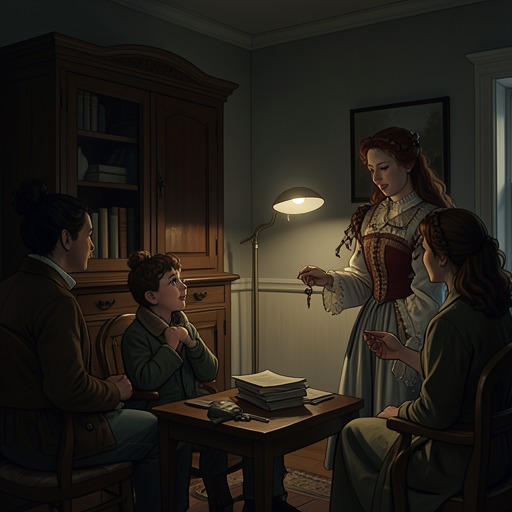
Austin has already instructed Maud to remember an oddly shaped key. He gives her a precise exception to the rule against surrendering it: if he is absent and Doctor Bryerly asks for it, she is to understand that request as authorized. The instruction establishes Bryerly as a trusted intermediary in Austin’s private arrangements, though Maud does not yet know the reason for the trust.
Bryerly arrives at Knowl unexpectedly to Maud, though evidently expected by Austin, and stays one night. He meets Austin twice in the upstairs study. Maud notices that her father seems unusually dejected, while Mrs. Rusk blames the Swedenborgians and describes the visitor as a lean, black-clad figure repeatedly going in and out of Austin’s room. Because she sees her father troubled in his presence, Maud begins to dislike Bryerly before she understands their connection.
Religion, Mystery, and Maud’s Fear
Maud’s unease is intensified by her incomplete understanding of Swedenborgian belief. In a discussion of death and the afterlife, Austin invokes Swedenborg as someone who can see beyond the limits of ordinary knowledge and tells Maud that her mother is not in the place she imagines. He then describes death as a gate through which people will eventually return home. These religious ideas give Maud an unfamiliar vocabulary for grief and the afterlife, but do not resolve her anxieties about her father’s association with the sect.
After Austin’s death, those anxieties recur in Maud’s grief. She wonders who the Swedenborgians were, how they gained such influence over her father, and whether their beliefs were true or heretical. In that fearful state, Bryerly seems to her to exercise an unexplained authority. The novel thus initially presents him through Maud’s limited perspective: his connection to an unfamiliar faith and his private meetings with Austin make him appear ominous, though his later actions complicate that impression.
Trustee and Critic of the Guardianship
At the reading of Austin’s will, Bryerly is identified as one of four trustees, alongside Lord Ilbury, Mr. Penrose Creswell, and Sir William Aylmer. The estate is held in trust for Maud, while Silas receives a bequest and the use of Bartram-Haugh for life under specified conditions. A separate provision appoints Silas Maud’s sole guardian until she reaches twenty-one, requires her to live under his care at Bartram-Haugh, and provides him with an annual payment of £2,000 for her maintenance, education, and expenses.
Bryerly recognizes the danger created by these combined arrangements. He explains to Maud that if she dies before turning twenty-one, the entire property will pass to Silas, while Silas controls her person and residence in the meantime. He had objected to the arrangement when Austin read him the will, and he continues to regard it as extraordinary. His warning puts the legal and personal stakes into plain terms: Maud’s father has entrusted her safety and the possibility of Silas’s inheritance to the same guardianship.
The private letters Austin left for the trustees explain the moral purpose he intended the arrangement to serve. He names Silas guardian to vindicate his brother’s reputation against what he calls a politically motivated slander, and presents the provision as an ordeal of purification: if Maud dies under age, Silas inherits, while Austin declares that he believes his daughter to be safe in Silas’s care. Reading the letters, Maud feels that her earlier reluctance to accept the arrangement has betrayed her father’s intention. Bryerly’s reservations therefore stand in tension with Austin’s stated confidence: he sees the structural danger that Maud’s father deliberately accepted as a public test of Silas’s character.
Confrontation at Bartram-Haugh
When Bryerly later visits Bartram-Haugh, he looks careworn and older to Maud. Silas initially refuses to see him, then sends for Maud to attend their meeting. By requiring her presence, Silas turns a dispute over the trust into a performance before his ward: he says Bryerly means to accuse him of robbing her and insists that he has nothing to conceal.
Bryerly answers in restrained, technical terms. He distinguishes robbery from what he considers the more accurate charge of thieving, then clarifies that Silas is exercising a power he does not lawfully possess. The result, he says, is to diminish the estate and benefit Silas at Maud’s expense. His allegation is specific: it concerns the use of authority over property and the resulting harm to the beneficiary, not simply Silas’s character or his past.
Silas responds by presenting himself as a changed and religious man, claiming to have remained within his legal rights despite financial hardship. He also attacks Bryerly’s motives, portraying the trustee as a poor-born Swedenborgian who has prospered through his position and its opportunities. This counterattack contrasts with Bryerly’s narrow focus on whether the estate is being improperly depleted. Maud witnesses both the public display of Silas’s penitence and Bryerly’s refusal to withdraw the practical question of her property.
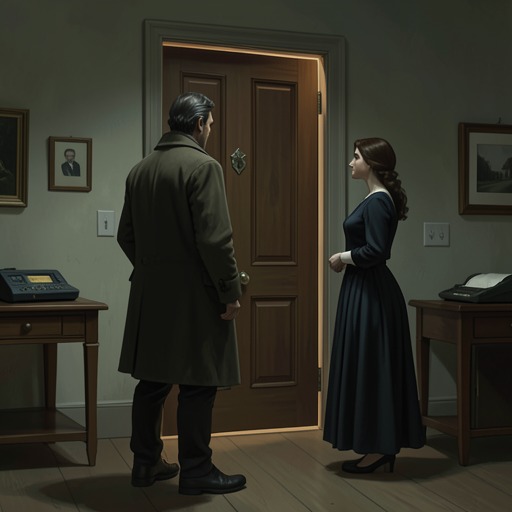
Silas bars Bryerly from the house, citing both his manner and unfavourable reports about him. Yet before leaving, Bryerly turns to Maud and offers to act if she can think of any way he might be of service. His offer is made in Silas’s presence, limiting what he can say or do at that moment, but it gives Maud a direct assurance of support.
Later Service and Narrative Significance
By the end of Maud’s account, her judgment of Bryerly has changed decisively. She calls him the truest of ministers and says that, after long persuasion and with her closest friend’s agreement, she asked him to manage the Derbyshire estates. She describes him as punctual, laborious, kind, and shrewd, and considers him particularly well suited to the responsibility. The appointment reverses the earlier image of an obscure religious influence whose authority Maud feared: the man she had once suspected becomes the trusted steward of the property whose protection he had insisted upon.
Bryerly also helps bring an unresolved crime into intelligible form. After Lady Knollys tells him how Dudley entered Maud’s room, he examines the windows of the room where Mr. Charke had slept on the night of his murder. He discovers that one window has concealed steel hinges sunk into its frame and secured by an iron pin on the outside; removing the pin allows the window to swing open. It is the same room in which Maud had been placed, and the hidden mechanism explains how the room was entered. Bryerly’s examination solves the problem of Mr. Charke’s murder by identifying a concrete means of access.
His character is ultimately defined by the distance between appearance and conduct. Maud initially sees him through the fears attached to Swedenborgianism and his closeness to her father; Silas later depicts him as self-interested. Against these suspicions, Bryerly’s actions show a consistent concern with Maud’s estate and safety, followed by reliable work on her behalf. His religious affiliation remains part of the novel’s atmosphere of uncertainty, but the narrative’s final assessment of him rests on demonstrated service rather than mystery.